Leadership Lessons From The Last of Us
- Jasminh Nguyen
- Oct 7, 2024
- 8 min read

Unlike trait-based leadership theories, which argue that great leaders are born with innate qualities, behavior-based theories suggest that leadership is about actions and decisions. Leadership, according to these theories, is not about who you are but what you do, and that behaviors that can be learned, adapted, and practiced.
People/Task Theory

The People/Task Theory determines two types of leadership. There's people-oriented leaders, who emphasize on job satisfaction, relationship building, positive work environments, and work-life balance for their employees. On the other hand, there's task-oriented leaders, who, emphasize on the specific tasks that need to be accomplished, organizes work, and focuses on getting things done efficiently.
Of course, there can be some drawbacks with this theory. There can be leader who only enforces rules and deadlines without considering the well-being of everyone else, which can be draining on the team. And there can also be the type of leader who focuses on being friends with everyone but fails to consider the work tasks, which can be just as harmful.
With that in mind, I personally don't think that one (people vs task) is better than the other. Great leaders should be able to balance between both people and task oriented behaviors, and apply them as they adapt to different situations or work environments. For example, I have been in high-pressure professional environments where deadlines need to be met, but at the same time, the team is not getting anything done due to low morale or motivation. In this case, it would have been great for a leader who can be flexible between both types of leadership approaches to step up and take charge.
Theory XY
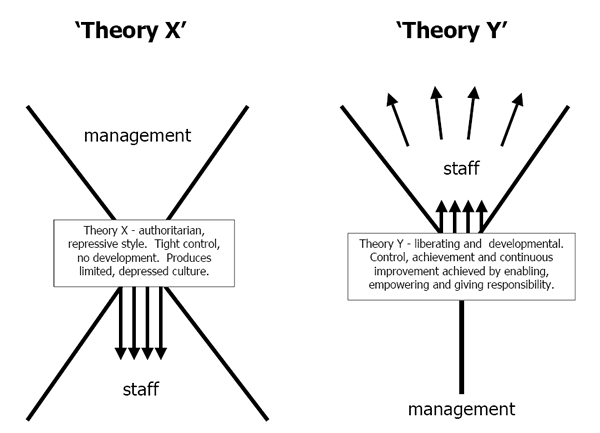
Theory XY is a different behavior-based leadership approach that understands the assumptions a person makes about people and human nature.
Theory X:
- Assumes employees are inherently lazy, avoid responsibility, and need close supervision.
- Leaders may use coercion and control to achieve goals.
Theory Y:
- Assumes employees are self-motivated, seek responsibility, and can be creative.
- Leaders provide autonomy and support to foster a motivated workforce.
I personally have mixed feelings with this behavior-based leadership theory. It seems very similar to the leadership theory mentioned above. Theory X aligns pretty closely with the task-oriented approach while Theory Y aligns more so with the people-oriented approach. However, in essence, they do highlight different ways of managing and interacting with others. When applied, I find Theory X to be harsh and strict. I personally have never worked for or with a person that is true to Theory X, but I would be afraid to.
It sounds like a Theory X leader would be micromanaging 24/7 and making all of the important decisions in the workplace on their own, which I disagree with. When I become a leader in the hospitality industry, I would want to create a work environment where I lead effectively to the point where I can trust those I work with to do jobs on their own without so much supervision. I would also include everyone in important decisions so that everyone feels like they play a part.
Leadership Styles

The three primary leadership styles are authoritarian (autocratic), participative (democratic), and delegative (laissez-faire). Each style has its own strengths and weaknesses.
Autocratic Leadership:
- Leaders make decisions on their own without much input from other team members.
- Effective in crisis situations requiring quick decision-making.
Democratic Leadership:
- Leaders involve team members in the decision-making process.
- Fosters collaboration and creativity but can be time-consuming.
Delegative Leadership:
- Leaders provide minimal direction, allowing team members to make decisions.
- Encourages innovation but may lead to a lack of direction and accountability.
Again, I am starting to see a pattern with these behavior based theories as I continue to examine them. Authoritative/Autocratic leadership aligns very closely with task and theory x leaders. On the other hand, delegative/laissez-faire leaders align closely with people and theory y leaders, while democratic leaders are a good mix of in between.
These 3 behavior-based leadership styles are easier to understand, in my opinion, and offer greater flexibility when it comes to the certain behaviors when interacting with others. In terms of my own leadership style, I would consider myself more of a democratic leader. I have adopted this leadership style because I truly enjoy the collaborative aspect of engaging with my team as a whole and hearing different perspectives and ideas.
Level 5 Leadership from Good to Great

Level 5 Leaders, a concept introduced by Jim Collins in his book, Good to Great, are characterized by a unique combination of humility and relentless professional will. Their ambition is directed toward the success of their organization, not personal gain, and they prioritize the long-term success of the company even after they leave. These leaders credit others for successes and remain undeterred by setbacks, viewing them as challenges to overcome.
What I particularly like about Collins' Level 5 Leadership theory is that he believes anyone can develop into this leader. Collins suspects that ordinary people have the potential to grow into this role, which questions if people are born leaders as it is implied in trait based leadership theory.
Everyone is essentially capable of being this type of leader, but the motivations are buried and or ignored and under the right circumstances, self-reflection, conscious personal development, mentor, teachers, loving parents, life experiences, and more can develop or mature someone into becoming a Level 5 Leader.
I really this leadership concept by Collins. It makes me feel empowered, hopeful, and inspired, especially since I am still trying to find my footing. And I like that it emphasizes how leaders are focused on having a sense of purpose and a lasting impact on their organization and people.
The Last of Us: A Glimpse into Leadership Dynamics

The Last of Us is a popular action-adventure game developed by Naughty Dog that was adapted into a TV series by HBO. The story is set in a post-apocalyptic world and follows the journey of Joel and Ellie as they are trying to survive and navigate through a world taken over by a fungal infection that turns people into zombies. As they navigate throughout the world, they find themselves encountering multiple groups with who have distinct philosophies, motivations, social dynamics and leaders.
1. FEDRA (Federal Disaster Response Agency): A government organization that maintains control over quarantine zones (QZs) in the post-apocalyptic world.
2. The Fireflies: A revolutionary group that opposes FEDRA's oppressive rule.
3. Kansas City Revolutionaries: This group, rises against FEDRA in Kansas City after a power vacuum is created.
5. David’s Group: David leads a small, isolated community that engages in cannibalism to survive.
6. Jackson Community: A relatively functional settlement where people work together to create a semblance of normal life.
Character's in The Last of Us Who Have Certain Leadership Styles

People-Oriented Leader: Tommy
Behaviors: Tommy is Joel's younger brother who he got separated from during the outbreak. He exhibits people-oriented leadership by listening and validating people's feelings, often communicating that he values the relationships he has between people in conversations. He is a great active listener and always tries to keep the peace, or mediate, between the people in his group when tensions or conflict arises. Tommy also initiates team building activities and encourages the members of his group to work together for survival and welcomes new people into his settlement with open arms. He took the time to teach Ellie how to hunt and protect herself and was invested in her success. At different points in the show, Tommy shows loyalty and is willing to put himself at risk to help others, whether it’s by joining a dangerous mission or stepping in during a conflict to protect those he cares about.

Task-Oriened Leader: Marlene
Behaviors: Marlene is the leader of the Fireflies and her main goal is to find a cure for the infection. She is very focused in planning and coordinating missions for her group to resist against FEDRA as well. She does a lot of the recruitment for new members and oversees their training. She delegates tasks to her group and ensures that the Fireflies have enough inventory of weapons, food, and medical supplies. As the leader, she also defines roles and responsibilities for her members. For instance, she relies on other Fireflies to assist with security and planning and is the main person to make decisions for her group. She is organized, efficient, and driven by the mission, sometimes at the expense of personal relationships.

Theory X Leader: David
Behaviors: In the show, David leads his group to follow a belief system that is similar to Christianity. He often refers to himself as a "shepherd," speaks about faith, and draws on biblical imagery as a facade for his cannibalism and frames this worldview to justify his actions. He uses this front as a tool for manipulation and control over his followers because he sees them as helpless beings. David has very strict control over his group and tells them what to do without listening to their feedback. He also instills terrifying fear among his followers by intimidating them and even resorting to violence to ensure compliance. He rewards his followers by feeding them when they're starving and ensures his group is protected under his control.

Theory Y Leader: Tess
Behaviors: Tess is associated with the Fireflies and is Joel's close partner and ally. They worked together as smugglers. She very much serves Theory Y Leadership through her collaboration and teamwork with Joel as they are business partners. She trusts Joel with their survival and includes him in decisions. She does show empathy toward Ellie and is protective of her and willing to take care of her well-being. Tess is very supportive when it comes to others taking risks and instills a level of confidence, especially in Joel.

Authoritative Leader: Kathleen
Behaviors: Kathleen leads the Revolutionaries who overthrew the FEDRA regime in Kansas City. Her leadership is particularly motivated by a personal vendetta against those who wronged her brother, who was killed by FEDRA. Kathleen is authoritative in the sense that she takes charge and provides clear direction. She expects compliance and often makes decisions on her own, focusing on maintaining control and order. She's commanding and bossy. She is also assertive and demands loyalty when it comes to completing missions. Basically, she sees herself at the top and instructs her subordinates to carry out her plans to achieve her overarching goals.

Democratic Leader: Joel (I <3 Pedro Pascal)
Behaviors: Joel is one of the main characters in the show who is tasked with escorting Ellie across the United States. He is very pragmatic and resourceful and often has to deal with the consequences of his own actions. In the show, Joel will include Ellie in decisions and values her opinions. For instance, when discussing their route or strategy, he allows Ellie to express her thoughts and preferences. He encourages Ellie to be independent and passes along his knowledge to her for her own greater good. Although timid and skeptical at first, he will often initiate open lines of communication and is a great listener. Joel takes the lead in most situations, however, he is aware that most times it is a team effort in order to survive.

Delegative Leader: Henry
Behaviors: Henry is a survivor living in secret with his younger brother, Sam, in Kansas City. Both brothers are running from Kathleen because he was involved in the death of her brother. His purpose in the show is to protect Sam at all costs. Henry empowers his younger brother to make his own decisions, especially when they navigate through dangerous areas. When Henry meets Joel later in the show, he recognizes Joel's skills and experience and trusts Joel to take the lead during their escape from danger, allowing Joel to make tactical decisions while they work together to survive. And throughout their journey, Henry often checks in with both Sam and Joel, valuing their opinions and ideas.

Level 5 Leader: Ellie
Behaviors: Ellie is the main character in the show. She exhibits personal humility and selflessness, Ellie often prioritizing the well-being of others over her own. She is very mature for her age since she is so young and this is likely caused by being born in the middle of the apocalypse. Her maturity also stems from near death experiences and the need to survive. She demonstrates a willingness to sacrifice things if it revolves those she cares about, particularly in her relationship with Joel. Ellie does make mistakes throughout the show, but learns from them as well. She is very strong willed, confrontational, and refuses to give up even when the odds are stacked against her. She does pursuit a greater cause because she knows that her immunity can contribute to a cure for humanity and is willing to sacrifice her life for that reason.
[Check out the new addition to my blog: inspirational leadership quotes on the home page of my blog site]


Comments